



What is Madhubani Art? Madhubani Art is a style of Indian Painting, named after a district in Bihar, India. It is known for: A. Stark Geometrical Patterns B. Vibrant Colors C. Side Profiles of Characters Madhubani Art often depicts scenes from Hindu epics, people’s relationship with nature, or nature itself. The Project In our Hindi class, we were tasked with creating our own Madhubani art piece. In most language classes, we become… read more about Madhubani Art - A Binary World Captured in Color »
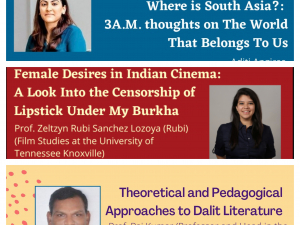
In our AMES 191 class, Dr. Knapczyk has made it one of her primary goals to give us real-world experiences and interactions with the topics that we explore within the classroom. At the end of our unit on Dalit literature and liberation, we forged attending a traditional class in favor of taking part in a discussion-based speaker series event that she facilitated. The event featured three well-known Indian academics: Professor Raj Kumar (of the English department at Delhi University), Professor Aparna Lanjewar… read more about Literature of the Indian Marginalized: Monthly Speaker Series »
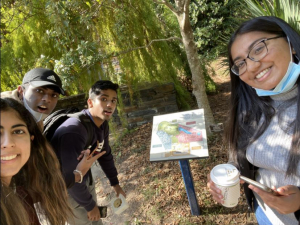
In Hindi classes, Kusum Ji always makes sure to do a variety of activities in our Hindi class to keep it interesting and engaging. Whether it's bringing in a guest every Friday to talk about cultural experiences or just playing fun games, or just having fun group activities to do during class while we learn Hindi, she takes it upon herself to keep it interesting. As a part of that, she came up with the idea for a scavenger hunt, as a way to celebrate Diwali. The class separated into groups, each with their own… read more about Scavenger Hunt in Duke Gardens »
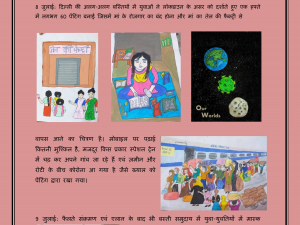
Every semester, Kusum Ji has exposed us to various aspects of Indian culture and allowed us to explore different issues plaguing India. This semester, in Hindi 203, one of the activities to expose us to Indian culture was talking to people from the Delhi Young Artist Forum and to create a poster for them to help promote their cause. The Delhi Young Artist Forum is a Non-Governmental Organization (NGO) that seeks to educate the youth through multiple facets in order to combat social injustice. We had previously met with the… read more about Increasing Cultural Competency Through Meeting with NGOs »
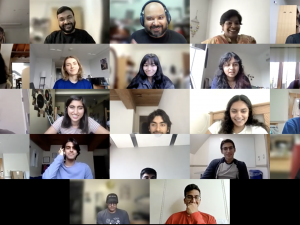
In all of Kusum Ji’s Hindi classes, she makes it her mission to help engage the class in a more interactive manner than simply lecturing and giving homework assignments. Throughout my semester in Hindi 101, I have had the opportunity to take part in activities that introduced me to new aspects of Indian culture and creativity, beyond the language, such as a dance class, a poetry workshop, and, my favorite, an acting workshop. Varoon P. Anand, the creator of a performing arts and production company called… read more about Duke Hindi Class Improv Session Student Reflection »
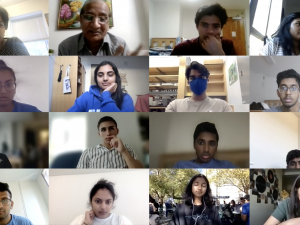
While everyone has celebrated the return to in-person classes at Duke this fall, the use of Zoom still holds a very important place in Kusum ji’s elementary Hindi course. Every Friday, students look forward to turning on their cameras and microphones to meet with members of the local and international Hindi-speaking community. Activities this semester have ranged from Bollywood Dance lessons to improv sessions, meetings with NGOs, and, most recently, a session with poet Jagdish Vyom. Born and raised in… read more about Poetry with Jagdish Vyom: Taking Hindi from the Textbook to Real Life »


That Squid Game became an international hit may have even surprised Netflix executives, but the international reach of Korean culture has been growing for a long time. However, the gorefest of “Squid Game” is another popular example of a particular genre of Korean films and TV shows, a genre that includes Bong Joon-ho’s “Parasite” and “Snowpiercer,” and even the zombie film “Train to Busan.” Like “Squid Game,” the terror of the action in these show is matched by the trauma created by a society built on extreme class… read more about Korean Film Goes Global »
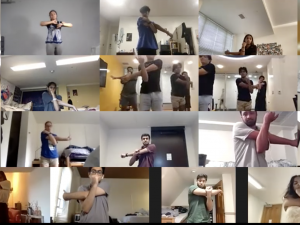
Throughout our semesters taking Hindi, one thing I have always enjoyed are the efforts by instructors to bring in speakers/presenters to class to expose my peers and I to a new and interesting aspect of Indian culture. One such effort was earlier this semester, when Kusumji brought in Anviksha Srivastava to our class. She is a student at UC Riverside with a passion for Bollywood dance and a fluency in Hindi. She came to teach us a few dance moves to a famous Bollywood song.… read more about Dance With Passion »

More than 50 people gathered in a Duke classroom both in-person and remotely this September to consider whether “Truth is a Linguistic Question” – a prompt provided by faculty leading the ongoing Sawyer Seminar Series on language discrimination in fragile and precarious communities. Funded by the Andrew W. Mellon Foundation, the series launched in spring 2020 and continued throughout the pandemic thanks to a combination of perseverance and the power of Zoom. This latest seminar kicked off a slate of events for this fall.… read more about ‘Truth is a Linguistic Question’ Talks by Five Trinity Scholars Relaunch Series on Language Discrimination »


Leah Okamura, a Japanese major student (Class of 2023) at AMES, participated in Japanese-English Conversation Table hosted by Hokkaido International Foundation (HIF), and her essay was published in Hakodate Shimbun (Hakodate Newspaper)! In her essay, Leah discusses how depopulation is currently impacting many areas in Japan, such as Hakodate. She explores the reasons as to why Hakodate’s population is shrinking and how this is affecting the local communities and infrastructure. As a… read more about Japanese Major Student Published in Japanese Newspaper »


Africanism and the Arab World. Capitalism and the Constitution. The items in each pair aren’t always considered together, but two Duke faculty members argue that doing so clarifies important facets of our world, and both will use National Humanities Center fellowships to make their case. Mbaye Lo, associate professor of the practice of Asian & Middle Eastern Studies and International Comparative Studies, and Nancy MacLean, William H. Chafe Distinguished Professor of History and Public Policy, are among the National… read more about Duke Professors Earn Fellowships to Study Overlooked Connections »
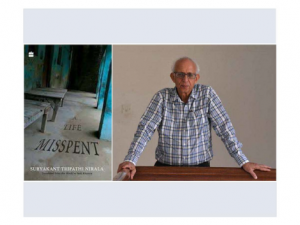
AMES Prof. Satti Khanna’s translation of Nirala’s memoir, Kulli Bhaat is noted in reflections by Gandhi’s grandson in the Kolkata Telegraph article on current circumstances in India. https://www.telegraphindia.com/opinion/rural-india-is-as-yet-unmapped-in-the-viruss-cartography/cid/1816443 read more about Identical Horror »
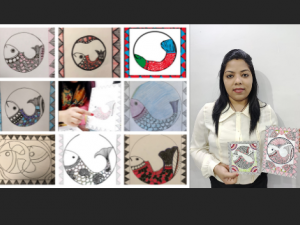
Throughout our Hindi classes students are not only exposed to the language and grammar of Hindi but also to the culture of Hindi speakers as well. Instead of creating American style cards this Valentine’s Day, our class was given a demonstration on Madhubani art by University of Delhi, Professor Priyanka Singh. Priyanka Singh teaches Hindi, and she also researches and practices different forms of Indian regional style art, including Madhubani art. Madhubani art is a style of painting practiced in the Mithila region… read more about Madhubani Art Class Demonstration - “The Fish is the queen of the water (मछली जल की रानी है)” »
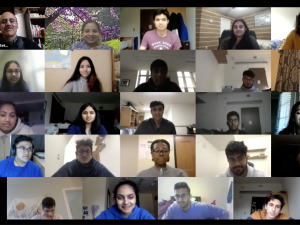
You are never too old to listen to a story. Even the simplest ones can have the ability to communicate a unique perspective of our world, whether they be emotionally intense or just an extended joke. And last month, Hindi 102 and 204 each had the pleasure of attending a short story workshop with Anurag Sharma. We learned how to use our growing knowledge of the Hindi language to share our own stories. For his day job, Mr. Sharma works as an IT Project Manager in a bank. But he is also the founder, publisher, and Editor-in-… read more about Short Stories with Anurag Sharma »
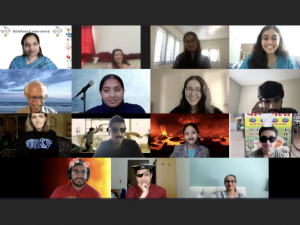
The Hindi Festival this year was an amazing immersion into the Hindi language. Its goal is to celebrate the work of Hindi students at Duke and to connect us further into Indian culture. We also had a lamp lighting, a poem performance by Manju Mishra, and a recitation of the Saraswati Vandana Mantra by Alka Bhatnagar. The festival was virtual this year because of COVID, but Hindi professors Kusum Knapczyk and Satti Khanna still made it very enjoyable. The Elementary Hindi students all performed skits in Hindi for the… read more about Virtual Hindi Festival »

In Hindi 204, Kusum Ji made it her mission to expose us to various aspects of Indian culture, such as poetry, stories, and dance. She did this through inviting a few guests to the class, where we’d get the opportunity to put our normal work on pause for a day and interact in Hindi with an expert on their topic of expertise. For one of these classes, Kusum Ji invited Rohini Thakkar from the Duke India Initiative, a Bollywood dancer and native Hindi speaker. Kusum Ji had invited Rohini Ji to my Hindi 203 class last semester,… read more about Dance with a Smile »
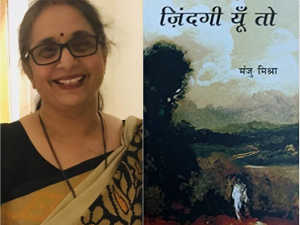
This semester, we had the pleasure of welcoming Manju Mishra, a Hindi poet. Here is her poem blog https://manukavya.wordpress.com/ We’d previously had experience with Hindi poetry last semester, when Bollywood lyricist Dr. Sagar led a workshop for us. Now with a broader vocabulary and more knowledge of grammar construction, the pressure was on to top our performances. Regardless of the language—Hindi or English—writing poems is no easy task. I, and most of my class, approached the workshop with a little bit… read more about Finding our flow: An introduction to writing Hindi Poetry »

This semester, students in HINDI 204 participated in a workshop called “Exploring Disinformation from a Multilingual Perspective: Fact, Rumors, and Lies about the Texas Power Crisis.” We participated along with other students who were studying Chinese, French, Italian, French, and Spanish to evaluate the factual accuracy articles written in their respective languages of study concerning the power outages in Texas this year. The aims of this workshop centered around exploring how disinformation spreads across multiple… read more about Exploring Disinformation Across Various Languages »

On February 27 and March 6, those of us in Kusumji’s Hindi classes had the opportunity to meet with girls from the Delhi Young Artists Forum (DYAF) and their supervisor Sadre Alam. The girls’ ages spanned from 9th grade to PhD students, so we got to hear many different stories of life and lockdown in India. I and a lot of other Duke students really appreciated being able to get their perspectives, and the girls were very open in sharing their experiences. Gulafsha said that she missed a train and got stuck far from home for… read more about Speaking Globally »

This past Tuesday, students taking Dr. Kusum Knapczyk’s Hindi 102 course got to cook an Indian breakfast staple, upma. Upma is a thick porridge or patty traditionally made from semolina flour, diced vegetables, and a variety of other ingredients. While it has origins in South India, hundreds of variations are popular across the subcontinent — and students got to create their own version in class. Using roasted vermicelli noodles, chopped vegetables, and an assortment of herbs and spices, students worked from a one-pot,… read more about Indian Cooking with a Few Ingredients »


BOOK EXCERPT A forest has fallen silent in grief in Vinod Kumar Shukla’s eerie new novel in translation An excerpt from ‘A Silent Place’, Vinod Kumar Shukla, translated from the Hindi by AMES Prof Satti Khanna. Twitter blurb here. read more about New Book Translated by Satti Khanna »